The idea of a remix is not new, though most often when people think of the word “remix,” they think of an altered version of a song that is noticeably different but recognizably similar to the original. I think today’s generation has taken the term “remix” and run with it so that things are being remixed in all areas, from music to images to literature to art to fashion to you name it. Books like Fool by Christopher Moore take a classic work like King Lear and remix it by making it focus on a peripheral character, thereby taking something we know and are used to and spinning it to make it new and exciting. I imagine books like Pride and Prejudice and Zombies and Sense and Sensibility and Seamonsters are literary remixes as well (they are termed “mash-ups” on Wikipedia, but they deconstruct and dismantle “others’ creative expressions” and reform them “into a new creative expression,” or, in the words of a student: “Taking something known and making it new and relatable” [Dail & Thompson, 2016]).
And remixing has only gotten easier with technology and tools at our fingertips. On a grand level, the internet and the ubiquity of social media platforms make it so easy to remix something and share it with others with whom it may be relatable. That’s why memes in the form of image macros as so popular and long-lasting (they’ve been around for at least a decade). I kind of pride myself on being around and aware when these sorts of memes started really becoming a thing in the dark corners of the internet and then ballooned into something that everyone and their grandma started using to share sentiments, stories, experiences, and opinions. I have loved seeing how memes have evolved over time; seeing how older memes have gained more and more history and intricacy as time goes on, seeing how new memes come and gain traction, and then survive or die off — both are very interesting to me as a connoisseur of good memes and as an interested observer of a particular culture.
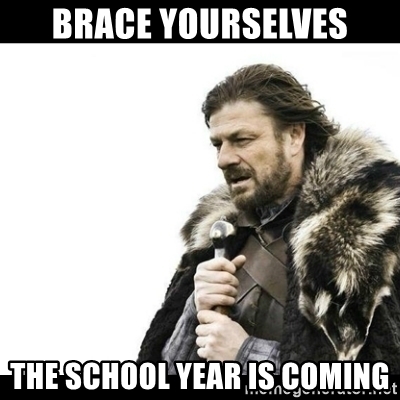
Watching students takes up this work of remixing texts such as images, sharing them with others, and interacting with them is very fulfilling to me as a teacher, perhaps because I see myself as part of this meme culture. Here is a meme I remixed to convey one strain of my feelings regarding the upcoming school year:
Upon Reflection:
Out of all the possible meme-tastic images I could have chosen to make a meme from, I chose this image because this past week I finished watching Game of Thrones with my husband (we loved it), and I felt I could now understand and take part in all of the GoT memes that I could not really enjoy before I had watched the show. On another level, I chose to create a meme as a remix because (A) like I said, I love memes (I did a 10-minute presentation at GCTE 2019 on using memes in the classroom), and (B) I think memes are a great and easy way to share a message that is often accessible to others. Even though I know others haven’t watched Game of Thrones, knowing that this particular meme is about “bracing ourselves” for an oncoming difficulty isn’t too hard to figure out if one has seen enough of this particular meme. While the top text often stays the same (“Brace yourselves”) and makes the meme understandable, the bottom text is what changes and makes the meme relatable to particular people who “get it.” The impending trial of my first full year as a teacher is a daunting challenge that looms over me, and I feel like it’s not impossible that my peers might feel this way as well — though let it be noted that I am also filled with excitement and joy at the idea of my oncoming first year.
Remixing this image like this — stamping a new meaning onto an inherent one that naturally comes along with the original context of the image — toys with the idea of double exposure because in essence the image conveys two different meanings that may be accessible to different populations. However, depending on if the audience has not watched Game of Thrones or if they do not know the anxiety that comes along with preparing to be a first-year teacher, it may not be as accessible to people as it could be. But, that seems to be the nature of memes.
However, to understand the background history behind this and other memes, websites like memegenerator.net are great sources to both easily make memes and understand the history behind them. I used memegenerator.net for making the meme in this post, and it was very easy for me to pick an image I wanted to use, put my top and bottom caption on top of it, save it, and add it to this post. I would recommend using memegenerator.net for use in the classroom, but right on the front page is the f-word, so I might suggest using another website like the imgflip.com/memegenerator because at least it might take some clicking around to come across a curse word, and it is similarly easy to use to make a meme. However, memegenerator.net seems a little more easy to find the exact image you might be thinking of using than the imgflip meme generator, so there’s that, but both websites could improve in terms of find-ability for the image you want (and both include a watermark if you are opting for the free version).
Memegenerator.net also provides some funny context information for each meme, and as a person who sees memes come and go, I appreciate that since sometimes I am completely out of the loop when it comes to how some memes come about or what they convey on a deeper level than the captions overlaid onto them. (knowyourmeme.com also has great and more in-depth background info, but it’s definitely Not Safe for Work.) With that, I’ll leave you with a few final thoughts about memegenerator.net:
- As teachers, we have to be *very* careful in directing students to use these sorts of websites to create their own memes because they may inadvertently be exposed to inappropriate content.
- How do you see you and your students using memes as remixes of images-as-texts in your classroom?
- Even though making and sharing memes is part of their daily interaction with each other, how do you advise that teachers take that interaction up in a safe and appropriate way?
- Tip: Click the “memes” link in the top middle to be directly brought to a page where it’s easier to find the meme you might want to use.
Dail, J. S., & Thompson, N. (2016). Talking Back: Remix as a Tool to Help Students Exercise Authority when Making Meaning. The Alan Review.
 Technology Trials and Tribulations