Images and other media can be remixed and modified to do things that we use simple text for, such as conveying meaning or making an argument. Below is an image I made that I hope conveys an argument through a visual media.
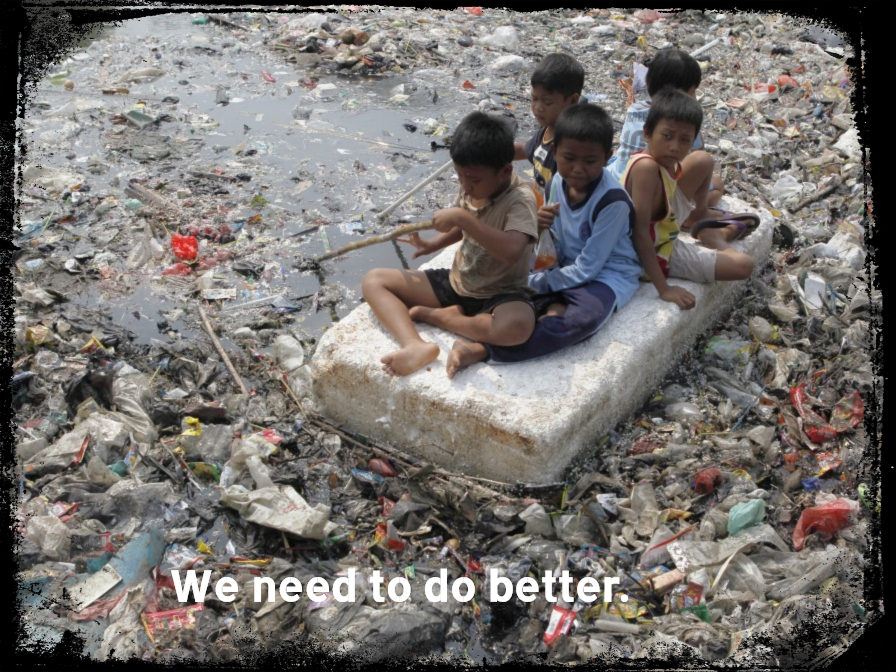
Upon Reflection: Essentially what I wanted to convey can be broken down into three core elements of what is known as the Toulmin model:
- Claim: We are not taking care of our environment and our children are suffering for it. We need to do better.
- Evidence: As shown in the image, children in third world countries are living and playing in huge amounts of trash that pollute their homes.
- Warrant: It is unacceptable that children are living in such deplorable conditions around the world; therefore, as concerned and responsible citizens of the world, we need to do a better job to take care of the environment for current and future denizens of the world.
This argument, however, comes from a person (me) who grew up in a relatively clean environment, at least on the surface. In the U.S. our trash is taken away to landfills and we happily go on our merry way without thinking about where that trash goes. We might recycle when we can, but don’t think too much of it if we end up throwing our aluminum cans or plastic bags in the trash. And because our immediate environment isn’t so bad — though it’s much worse in the cities, it’s nothing compared to pictures like the one above — it’s not something that’s on our mind too much. At the same time, if it is on our mind, then we’re in a unique position because pollution isn’t as “pressing” to us as it is in some other countries. These countries likely have a different view of pollution and environmental degradation than we do, and I don’t profess to know what that perspective is. On the opposite side of the spectrum, countries like Sweden and Japan are more cutting-edge and revolutionary when it comes to dealing with waste, and they also likely have a different perspective when it comes to this situation, and especially how to deal with it. The claim-evidence-warrant that I propose here may be slightly or significantly skewed based on whose cultural perspective it is coming from.
In order to create this visual argument, I used a platform called BeFunky, which I wholeheartedly endorse. I searched something like “free image editor” in Google, and BeFunky was one of the options that appeared. After a quick search on the FAQ page, I learned that BeFunky is indeed free, and wow, the things that it allows you to do for free are just mind-blowing. I found the picture from PBS, uploaded it to BeFunky, and played around with the panel on the left-hand side that offered numerous options to edit the image, such as add filters, overlays, text, etc. I was really blown away by all the possibilities on BeFunky, and would definitely recommend it to not only teachers who want to quickly and easily edit an image with text, but also to aspiring students or others who may be interested in graphic design or editing platforms for whatever their need may be.
BeFunky claims that “Beyond the top rated Photo Editor, Collage Maker, and Graphic Designer, BeFunky develops innovative digital media tools that allow users to express themselves creatively, without the need of any advanced technical knowledge. We strive to provide the best possible image editing capabilities with the easiest possible application, truly allowing anyone to be, well…funky!” From what I could tell with my experience with BeFunky, this claim is on point. I really don’t have much to say in terms of BeFunky’s constraints — of course, there are more options afforded if you pay for the upgraded version, but aside from that, I can’t find anything that BeFunky is lacking (though this may be because I have zero experience in image editing and don’t know what to look for).
I can definitely see BeFunky being used in the classroom for things like visual arguments and even simple image editing for projects that require students to work with images. I even found BeFunky to be easier than PowerPoint, even with its added capabilities.
- I definitely suggest playing around with BeFunky more than I did and exploring the extent of what it can do. Feel free to report back and show what you found out!
- How do you envision using an image-editing platform like BeFunky in your classroom? Can you think of specific projects or activities you would like to use it for?
- If you are more familiar with image-editing platforms, have you noticed any constraints with BeFunky that I didn’t notice?
 Technology Trials and Tribulations